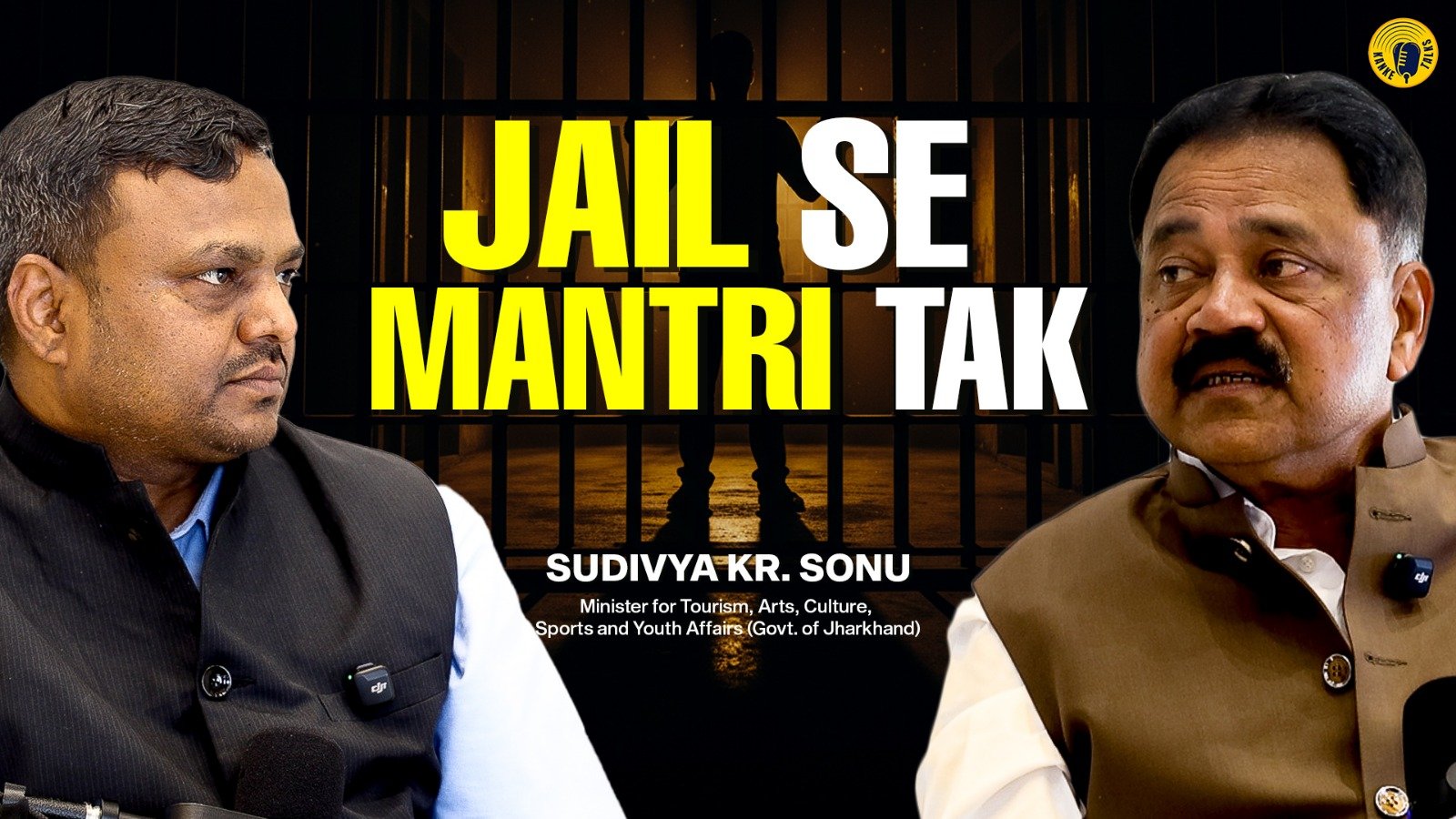
The Minister for Tourism, Youth Affairs, Skill Development, and Higher & Technical Education, Sudivya Kumar Sonu, sits down to discuss his journey from student activist to a key strategist in Jharkhand politics, reflecting on his relationship with Shibu Soren and the rise of Kalpana Soren.
Q: Most young people enter politics with a clear career path in mind. What were the initial circumstances that led you into this field?
A: My entry into politics was never about a career or a profession. My father was a government employee in undivided Bihar. However, I grew up during the 80s and 90s, when the Jharkhand movement was gaining national momentum. I personally faced derision and taunts from my classmates in North Bihar for being from Jharkhand. When I returned home in ’91, I met Guruji (Shibu Soren) in ’89 or ’90. He put his hand on my shoulder and said,“If educated people like you do not join the movement for a separate state, how will it grow?” That moment became the decisive factor that shaped the direction of my life. It was a spontaneous process, not a calculated decision.
Q: You came from a middle-class background. Surely your father must have objected to you joining politics instead of seeking a government job?
A: Absolutely. In middle-class families, the expectation is that the son will secure a government job. My entire known ancestry of four to five generations were all salaried employees. I was the first to enter politics. My father felt I had wasted my life. I had to face a lot of opposition at home. He would constantly worry about my lack of fixed timings or a stable profession.
Q: Speaking of your father, you mentioned a touching incident involving Shibu Soren that finally settled the conflict at home. Can you share that moment?
A: This is a truly remarkable event in my life, which highlights Shibu Soren’s mastery of human psychology. Around 2004 or 2005, when I was close to Guruji, he suddenly asked to visit my home in Dhanbad for tea. My father, who was retired and had a quick temper, was reluctant to meet him. I was stuck between a rock and a hard place. Finally, when my father came out, Guruji bowed down to touch his feet. The next thing Guruji said to him was profound: “I am taking your son with me, I will make something of him.” Until the day my father passed away in 2023, I never faced any more criticism from him about my political life. I had never told Guruji about the troubles at home, yet he somehow knew and solved the problem for me.
Q: Many people see Shibu Soren as a genuine leader, a ‘Guruji’. How would you describe his character, having worked with him for 20 years?
A: Personally, I firmly believe he was a saint, not a politician. He had no character flaws to speak of. He rose from struggle and deprivation. Critically, despite leading such a huge statehood movement, he was never a proponent of violence. He embodied the non-violent ideology of Mahatma Gandhi. His strength was his connection with the common man and the ability to build relationships not just with the workers, but with their families.
Q: You mentioned the politics of “ideology” versus the politics of “current” (Dhara). Do you believe that the art of building strong, lasting relationships is missing in today’s politics?
A: Definitely. Today, professionalism has taken over. In the early days, relationships were meant to last; there was no thought of changing party flags or ideologies overnight. We believed that a bond forged through ideology was greater than a blood relationship. Today, a doctor treats a patient professionally; they don’t get emotional over the patient’s pain. That detachment, that professionalism, is what we see in politics now. It’s more of a commercialisation of relationships.
Q: You have an image of a simple, ordinary politician, yet many others strive for a ‘Baahubali’ (muscle-man) image. Why did you choose a different path?
A: I live by an adage: “Do not do unto others what you do not like yourself.” If I am uncomfortable seeing a leader with a rifle or an intimidating entourage, why would the public like it? I don’t use a board on my official vehicle, and my siren is shut off before I enter my constituency. If a leader appears suddenly rich or powerful, the common man feels alienated. To maintain a bond, one must remain accessible and ordinary.
Q: The JMM government came to power in 2019. What was the biggest challenge you faced after taking office?
A: The biggest challenge was undoubtedly COVID-19, which hit soon after we formed the government. However, the government, under Hemant Soren, handled it with great skill. We started ‘Didi Kitchens’ and even kitchens in police stations to ensure no one went hungry. Crucially, while starvation deaths were reported in Jharkhand in ordinary times, not a single such death was reported during the entire Corona period. This was due to expert management. Our success in 2024 was also heavily driven by our women-centric schemes, like the Sarvjan Pension for women at 50, and the Savitribai Phule Kishori Samriddhi Yojana, which has significantly reduced the girl child dropout rate.
Q: As a key strategist, can you share a “behind the war room” incident from Kalpana Soren’s emergence during the 2023 political crisis?
A: When the idea of her entering active politics was floated, she was extremely hesitant. She was happy running her school and being Hemant Soren’s wife. We had to explain that a husband’s sympathy naturally goes to his wife, and she could not back down when the party and family were in crisis.
The emotional turning point came at her official launch on March 4, 2023. Addressing a crowd of 25,000 for the first time, she was overwhelmed and her voice cracked. I immediately took the microphone and began shouting the old Shibu Soren slogan, adapted for the moment: “Jail Ka Tala Tootega, Hemant Soren Chhootega.“ The 30-40 seconds of that highly charged slogan in the atmosphere where the leader was in jail, and his wife was shedding tears, galvanized the people and allowed her to compose herself.
Q: You predicted her becoming a big leader within just 3-4 days. Do you believe Kalpana Soren is ready for a larger role in politics?
A: She already is a big leader in Jharkhand. I believe she has the potential to become a big national-level women’s leader. Having spent 37 years in politics, I have a clear understanding: Leaders are born, not made. Kalpana Soren is born as a leader.
To explore in depth the struggles of Jharkhand politics, the towering personality of Shibu Soren, the rise of Kalpana Soren, and the emotional personal stories of a resilient MLA, be sure to watch the full episode on the KankeTalks Hindi Podcast.